Mountains do not rise to be admired. They rise because the Earth, every so often, needs to remember how big it is — and how patient.
Scroll to enter
Introduction
A mountain is geology made vertical. It is the slow argument between two continents pressing against each other for thirty million years, until one of them is forced to take the long way up.
Mountains shape almost everything we love about this planet. They make rain. They make rivers. They make weather. They isolate species long enough for evolution to do something extraordinary. A quarter of all terrestrial biodiversity lives on slopes — and almost every great civilization began at the foot of one.
To climb is to leave the noisy world behind in layers — first the towns, then the trees, then the birds, and finally the air itself. What is left at the top is a silence so complete you can hear your own thoughts settle.
8,849 m
Highest peak (Everest)
25%
Of biodiversity
1.1B
People rely on them
30M yr
Himalayas still rising
01The geology
Continents folded into the sky.
The Himalayas were once an ocean floor. India crashed into Asia roughly fifty million years ago, and the seabed had nowhere to go but up. Marine fossils now sit four miles above sea level. The range still rises by about a centimeter every year — a slow argument that has not yet ended.
02The zones
An entire continent in a single climb.
Walk a great mountain from base to summit and you will pass through more ecosystems than you would crossing a continent. Tropical foothills give way to temperate forests, then to alpine meadow, then to bare rock, then to permanent ice. Each band is its own country, with its own residents who would die if they tried to live in the band above or below.
03The water towers
The faucets of the world.
Nearly every great river on Earth begins as snowmelt. The Ganges, Indus, Mekong, Yangtze, Amazon, Nile, Rhine — all of them are gifts from the high places. More than a billion people depend on mountain meltwater for drinking, farming and electricity. When the glaciers go quiet, the world downstream begins to die of thirst.
04The high air
Where the sky becomes thin enough to taste.
At eight thousand meters, the air carries a third of the oxygen at sea level. Bar-headed geese fly over the Himalayas anyway, twice a year, with hearts and blood evolved exactly for this. Snow leopards stalk blue sheep at five thousand meters. Tibetan villagers grow barley at four thousand. Life, on slopes, refuses to be told no.
“
A mountain teaches a single, unanswerable lesson: that small is also a kind of beautiful.
Wildlife
Lives that hold to the slopes.
Snow leopard
Panthera uncia
Lives at 5,000m, can leap fifteen meters in a single bound, and is almost impossible to see — even when looking straight at it.
Bar-headed goose
Anser indicus
Crosses the Himalayas twice a year at altitudes that would kill an unacclimatized human within minutes.
Andean condor
Vultur gryphus
A three-meter wingspan and the ability to soar for hours without a single flap, riding thermals along the spine of South America.
Geography
The great ranges of the world.
From the Andes spilling down the Americas, to the Alps that gave Europe its rivers, to the impossible vertical country of the Karakoram — Earth's mountain ranges trace the slow choreography of moving continents. Together they cover roughly a quarter of all land.
Himalayas
2,400 km
Andes
7,000 km
Rockies
4,800 km
Alps
1,200 km
Field Discoveries
Curious things we learned along the way.
01
Everest grows in your lifetime.
Tectonic forces push Everest about four millimeters higher each year — though erosion gives some of it back.
02
Mountains make their own weather.
A range tall enough forces air upward, cools it, wrings water out of it, and creates lush slopes on one side and deserts on the other.
03
Trees that cannot stand straight.
At the treeline, conifers grow stunted and twisted into shapes called krummholz — wind-sculpted bonsai the size of buildings.
04
Glaciers carry sound.
On still mornings, a high glacier can carry the crack of distant ice for tens of kilometers — the mountain talking to itself.
05
Tahr that defy gravity.
Himalayan tahr scale near-vertical cliffs on hoof pads softer than rubber, gripping rock no human climber would consider holding.
06
Snow with its own colors.
High glacial snow blooms pink in summer from algae that photosynthesize in cold — known to climbers as 'watermelon snow.'
Field Gallery
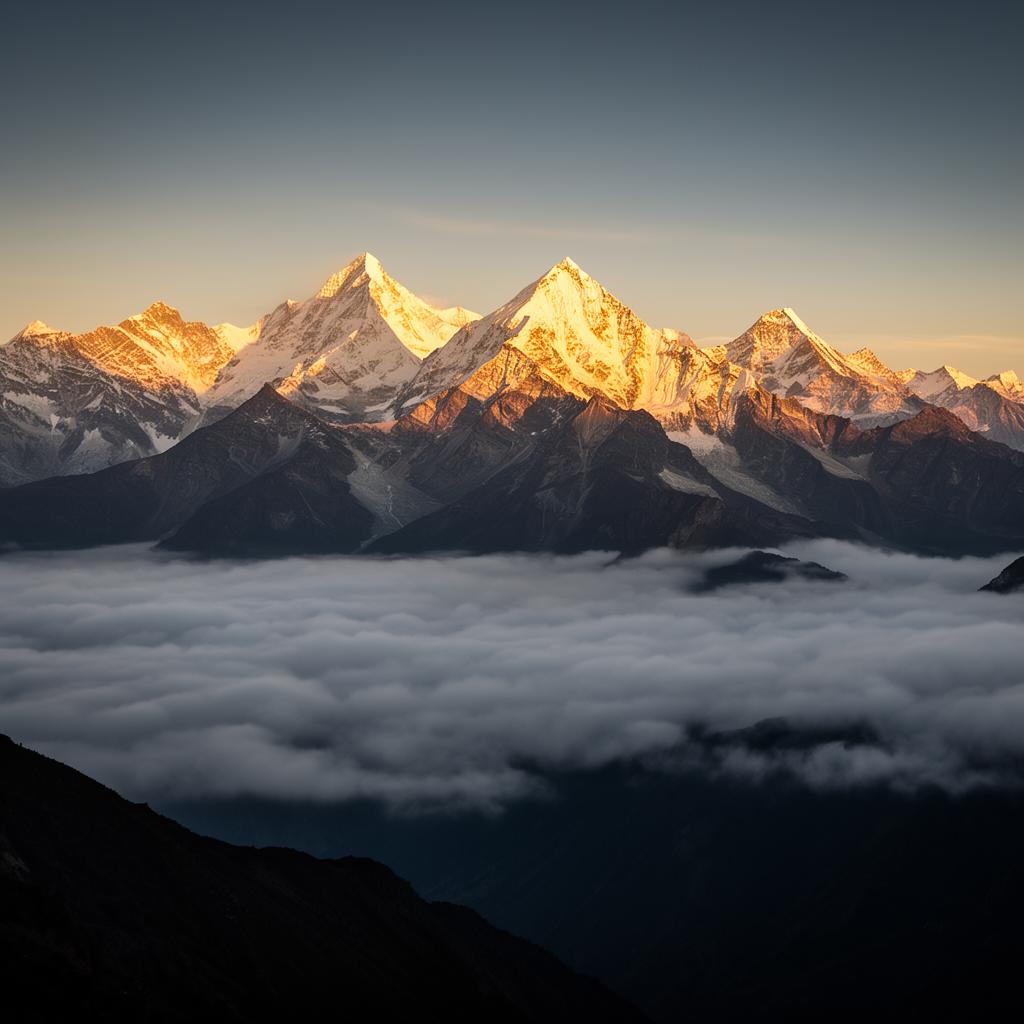
Khumbu · Nepal
Bernese Alps · Switzerland
Andean condor · Patagonia
Cascades · USA
Field portrait
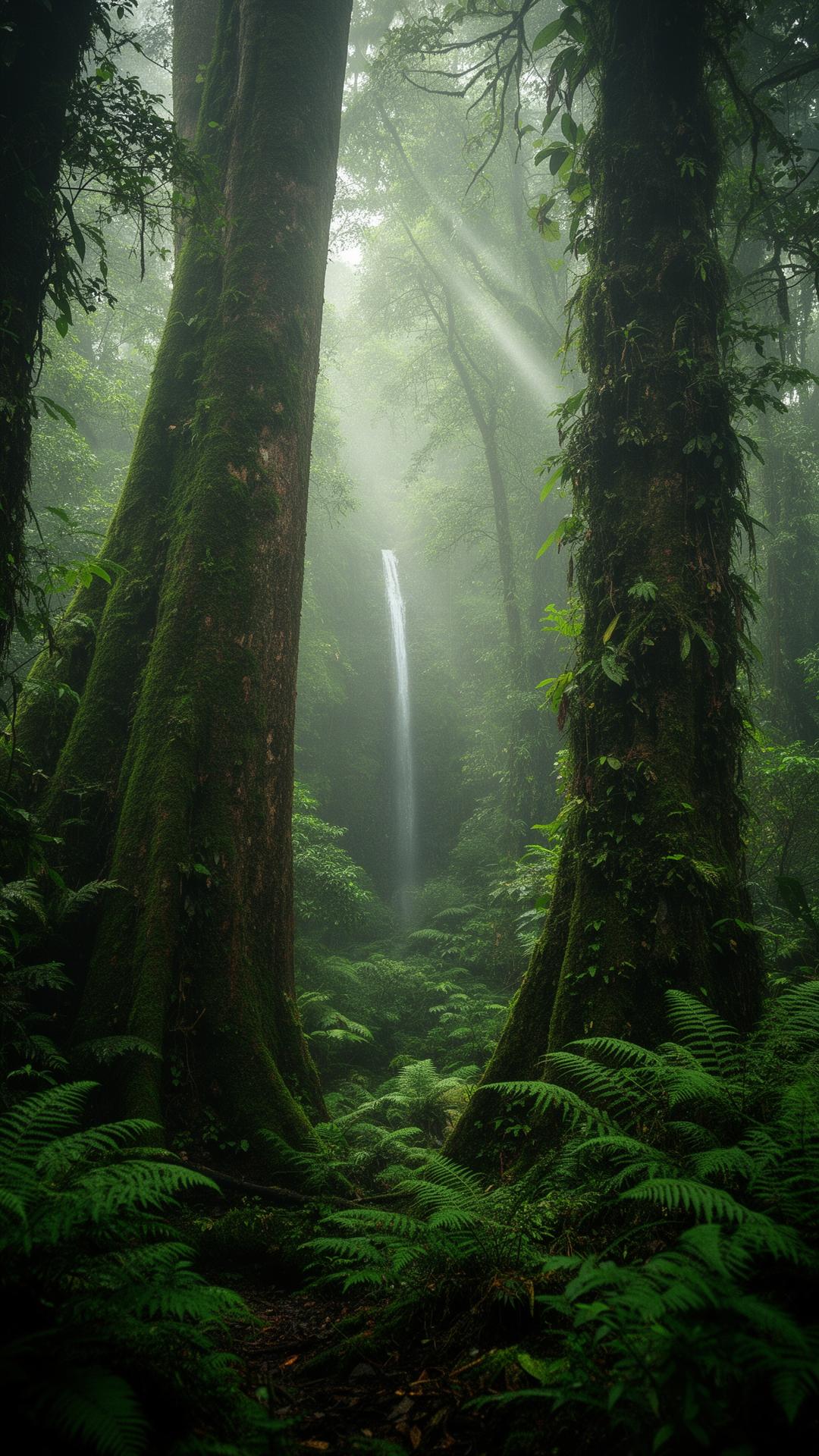
Andean cloud forest
Conservation
The glaciers are leaving, and they are taking the rivers with them.
Mountain glaciers store almost seventy percent of the world's fresh water. Most are shrinking faster than at any point in recorded history. The consequence is not abstract — entire river systems, the agriculture they support, and the cities that depend on them are at stake within decades. Mountain ecosystems are also some of the most fragile on Earth: warming pushes species uphill until, eventually, there is no more uphill left.
01Support indigenous and local communities who steward mountain landscapes.
02Choose certified-sustainable tourism — gear, guides, lodges and routes.
03Reduce personal emissions; mountain climates are first to feel them.
04Back glacier-monitoring science: the World Glacier Monitoring Service, ICIMOD, and partners.