Seventy-one percent of our planet, and we have mapped less of it than we have of Mars. Every drop holds an ancestor of ours, still swimming.
Scroll to enter
Introduction
The ocean is the oldest place on Earth. Life began in it. Most life still lives in it. Every breath you take — roughly one in two — comes from microscopic plankton drifting in its sunlit surface.
It is also the largest unexplored region in the solar system. We have detailed maps of the far side of the moon and the surface of Mars; we have detailed maps of less than a quarter of our own sea floor. Down there, in the cold dark, are mountain ranges longer than the Andes, hydrothermal vents hotter than any oven, and ecosystems that have never seen the sun and do not miss it.
If you want to know what this planet is, do not look up. Look down.
71%
Of Earth's surface
50%
Of all oxygen
<25%
Of sea floor mapped
11 km
Deepest point
01The manta
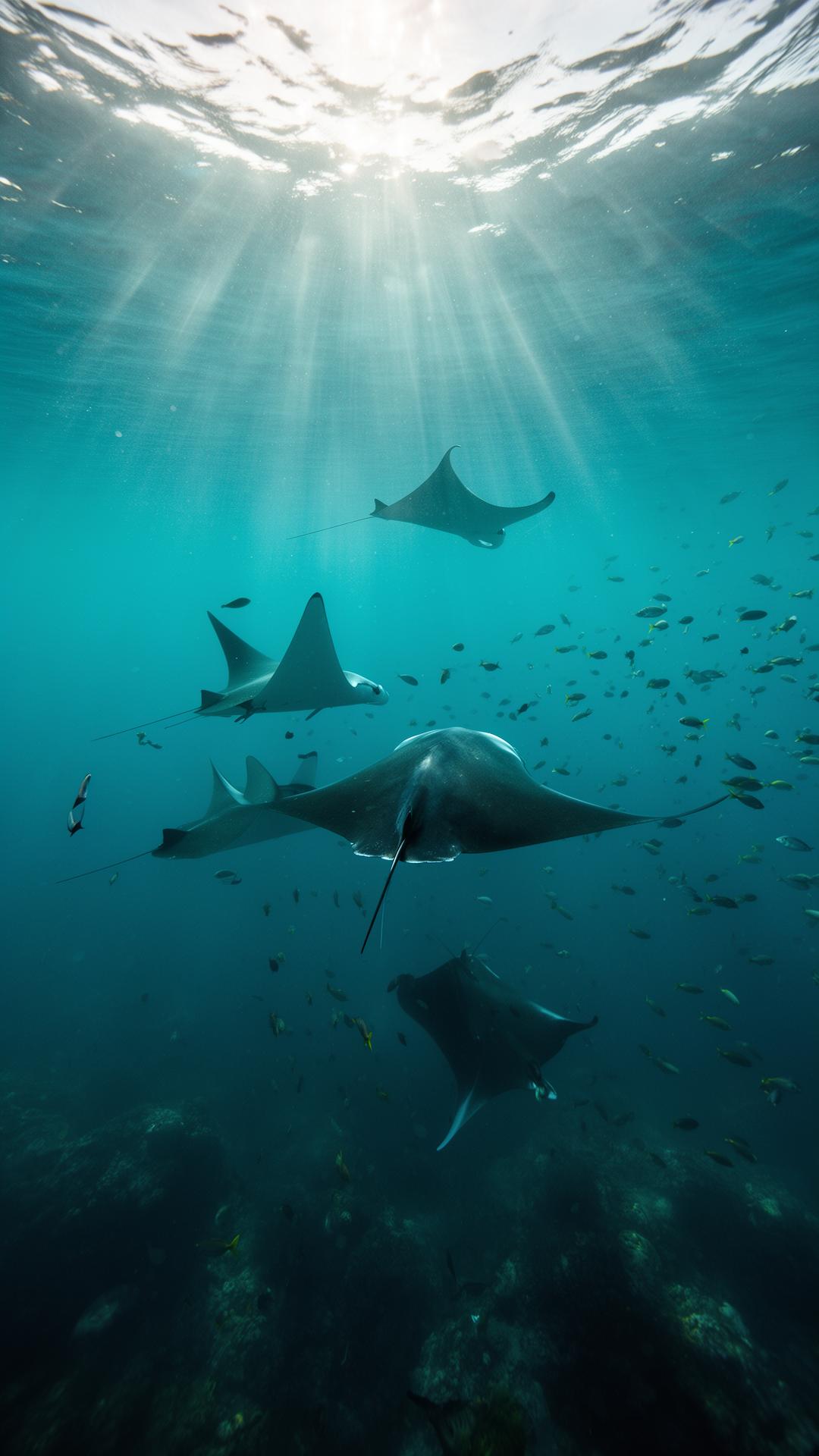
Seven meters of weightless grace.
A manta ray has the largest brain-to-body ratio of any fish, and it remembers. It returns to the same cleaning stations year after year, recognizes individual divers, and seems — and we say this carefully — to be curious about us. To watch one bank slowly past, the size of a small car, is to feel briefly, mercifully small.
02The reef
A city built by something smaller than a grain of rice.
Every coral reef on Earth was built, polyp by polyp, by tiny animals patient enough to work for a thousand years on the same wall. Reefs cover less than one percent of the sea floor, yet support a quarter of all marine life. They are dying now, faster than they can build. We owe them at least the courtesy of remembering — and the effort of cooling the water back down.
03The whale
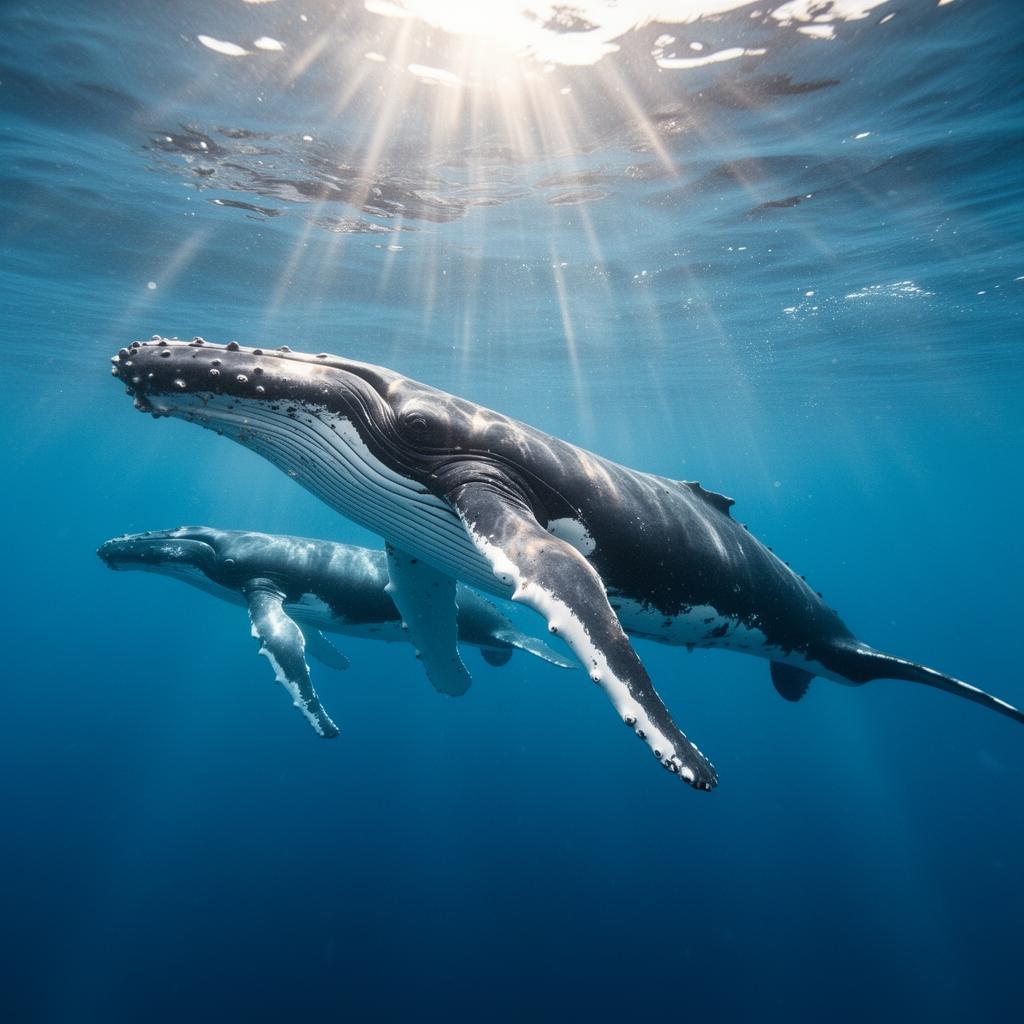
The largest heart that has ever beat.
A blue whale's heart is the size of a small car and beats once every ten seconds at the surface, twice a minute on a deep dive. Its tongue weighs as much as an elephant. Its call can be heard across an entire ocean basin. It eats almost exclusively krill — animals smaller than a thumbnail — by the tonne. Restraint, again. Always restraint.
04The deep
Where the sun has never been.
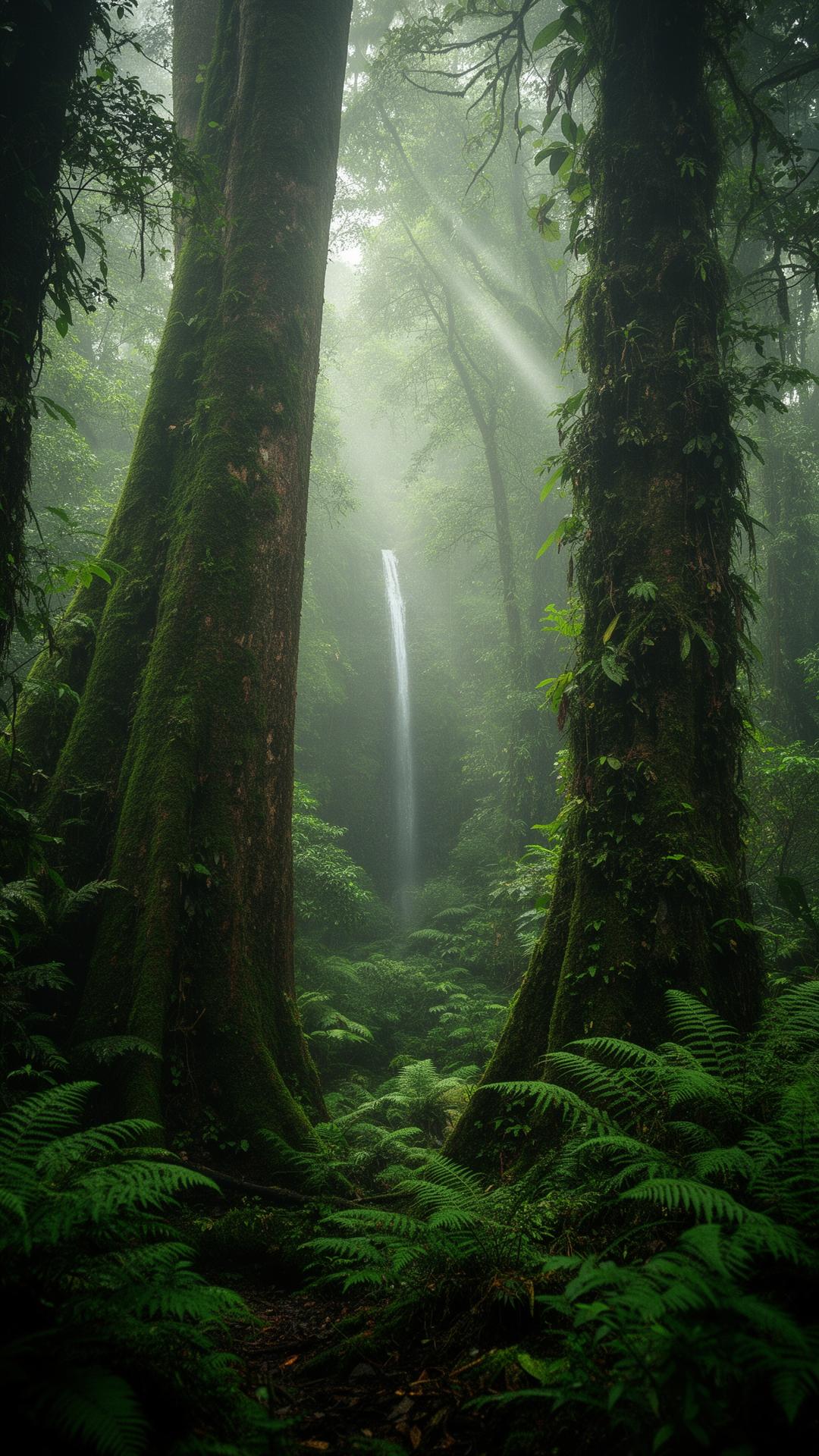
Beneath two kilometers of black water, entire ecosystems thrive without ever knowing daylight. They feed on heat from the Earth's core, drawn through hydrothermal vents into a chemistry-driven food web that has nothing to do with photosynthesis. Life, it turns out, does not actually need the sun. It only needs an opportunity.
“
The ocean is not silent. It is simply speaking a language we have not yet been quiet enough to hear.
Wildlife
Lives in the blue.
Blue whale
Balaenoptera musculus
The largest animal that has ever lived — bigger than any dinosaur — with a song that crosses oceans.
Giant manta ray
Mobula birostris
Seven-meter wingspan; one of only a handful of species that has passed the mirror self-recognition test.
Coral polyp
Anthozoa
An animal that builds limestone cities, feeds on light through partner algae, and lives for thousands of years collectively.
Geography
Five oceans, one connected body of water.
There is technically one ocean — we divide it into five for convenience. The Pacific is wider than the Moon. The Atlantic is still slowly growing as the seafloor spreads. The Indian holds the warmest water. The Southern circles Antarctica and powers global currents. The Arctic is the smallest, coldest, and changing fastest.
Pacific
165M km²
Atlantic
85M km²
Indian
70M km²
Mariana Trench
10,994 m
Field Discoveries
Curious things we learned along the way.
01
The ocean has rivers.
Underwater rivers of denser, saltier water flow along the seabed for thousands of kilometers — complete with banks, rapids and waterfalls.
02
Jellyfish are immortal.
Turritopsis dohrnii can age in reverse, returning to its juvenile form indefinitely — the closest thing biology has to a 'cheat code.'
03
Whales fertilize the planet.
Whales bring nutrients up from the depths in their waste, fueling plankton blooms that produce a measurable fraction of the world's oxygen.
04
There is more gold in the sea than on land.
An estimated 20 million tonnes of dissolved gold floats in the world's oceans — but in concentrations far too low to ever extract.
05
Coral reefs talk.
Healthy reefs are loud: snapping shrimp, popping fish, the crunch of parrotfish chewing rock. Recordings of healthy reefs played underwater can attract young fish to recolonize damaged ones.
06
Octopuses have nine brains.
Eight little ones, one in each arm, plus a central brain — the arms can solve problems independently of the rest of the body.
Field Gallery
Maldives
Tonga
Coral Triangle
Pacific coast
Sundarbans · India
Tide-pool life
Conservation
We have changed the chemistry of the sea in a single century.
Ocean acidity has risen thirty percent since the industrial revolution. Half the world's coral reefs are gone. Fish populations have collapsed in many regions, and roughly eleven million tonnes of plastic enter the sea every year. The ocean is also remarkably resilient — fisheries recover where they are given protection, and reefs regrow where the water cools. Almost everything that has been damaged here can still be repaired, if we choose to.
01Support marine protected areas — they work, fast, when they are enforced.
02Choose sustainably-caught seafood (or skip it); cut single-use plastic at the source.
03Fund ocean science and conservation: Oceana, Ocean Conservancy, Mission Blue.
04Reduce carbon emissions — the single biggest gift you can give the sea.