A waterfall is the simplest piece of music ever written — water, gravity, stone, and the willingness to keep going.
Scroll to enter
Introduction
A waterfall is a wound in a river — a place where the land has refused to soften, and the water has refused to stop. The two have been arguing for millions of years, and the water, patient and infinite, always wins.
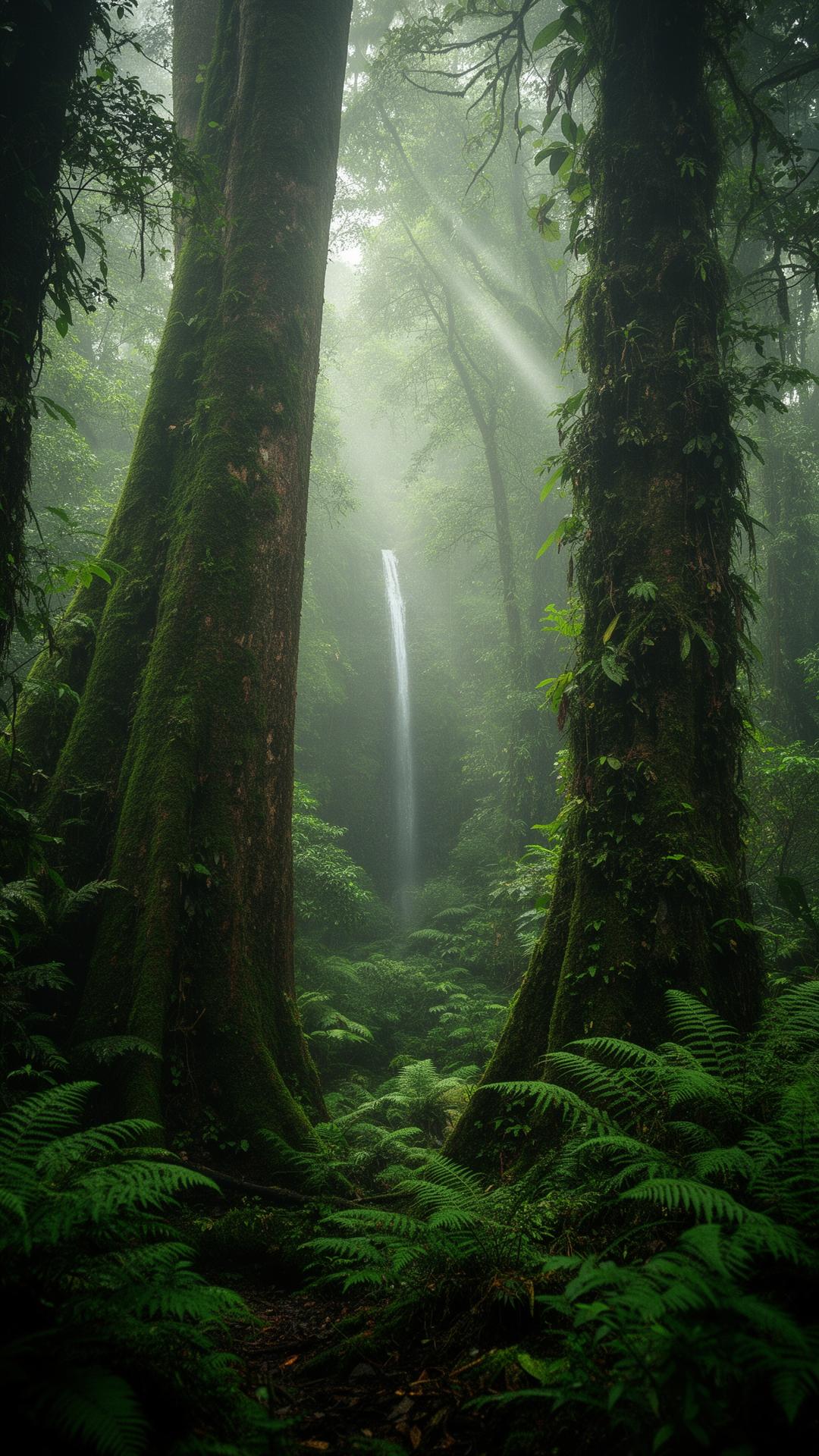
The mist around a great cascade is its own ecosystem. The air is permanently saturated, the rocks are permanently green, and rare plants grow nowhere else on Earth. Hummingbirds nest behind the curtain of water. Frogs evolve toes that can grip wet stone. Entire micro-worlds bloom in the spray zone.
Waterfalls are also the planet's clearest, loudest reminder of erosion — that even mountains, given time, will become beaches.
979 m
Tallest (Angel Falls)
10,800 m³/s
Iguazú peak flow
275
Iguazú cascades
12,000 yr
Niagara retreating
01Angel Falls
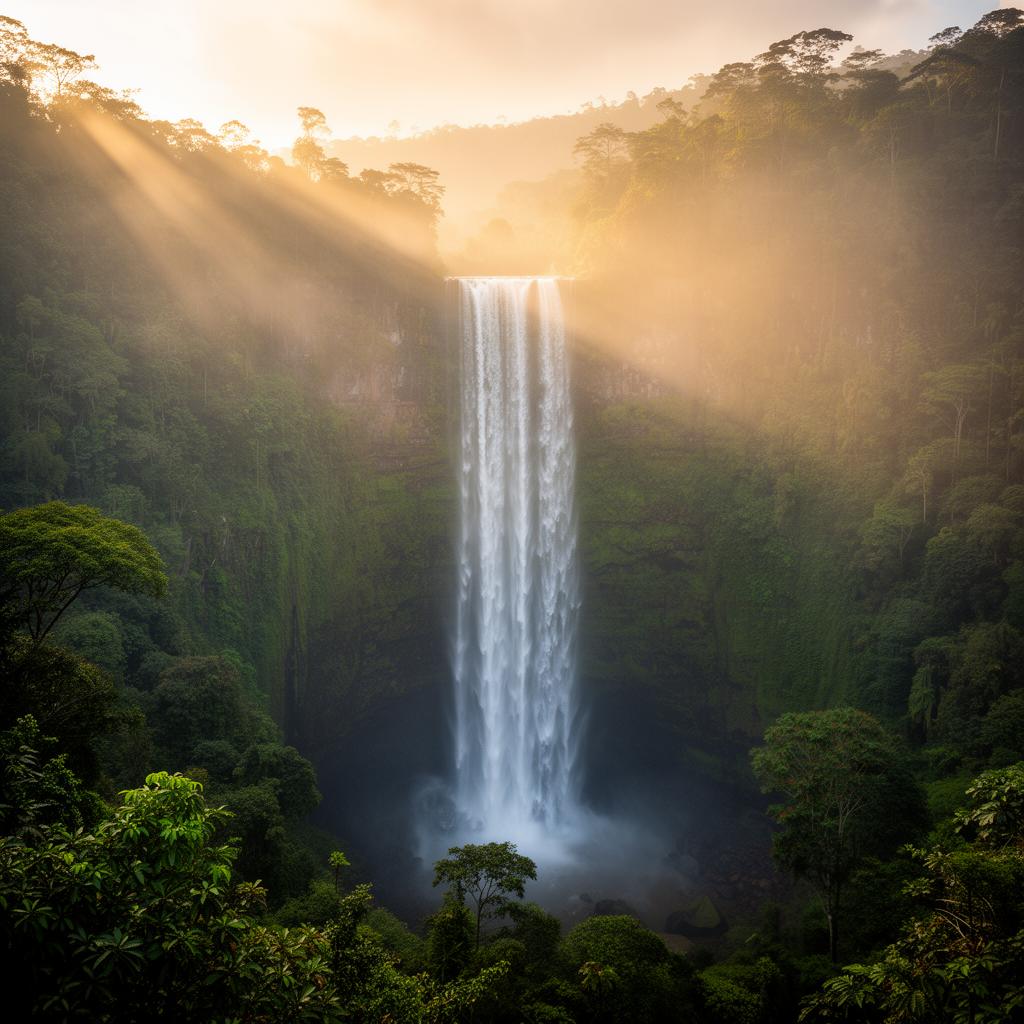
A river that falls almost a kilometer.
In the heart of Venezuela's Canaima rises Auyán-tepui — a flat-topped mountain that should not exist. From its lip, the Kerep River steps into nine hundred and seventy-nine meters of open air, becoming mist long before it reaches the forest below. In the dry season, the falls disappear entirely on the way down. The water arrives as rain on its own basin.
02Iguazú
Two hundred and seventy-five throats of thunder.
On the Brazil–Argentina border, the Iguazú River widens to four kilometers and then falls off the world. Two hundred and seventy-five separate cascades pour into a horseshoe canyon, the largest of them named Garganta del Diablo — the Devil's Throat. The sound is felt before it is heard, in the chest, kilometers away.
03Victoria Falls
The smoke that thunders.
The Kololo people called it Mosi-oa-Tunya — the smoke that thunders. The Zambezi falls into a single, narrow basalt slot more than a hundred meters deep, sending spray three hundred meters into the sky. The spray waters its own miniature rainforest on the opposite cliff, a green ribbon visible from space.
04The spray zone
Tiny worlds, perpetually wet.
The mist around great falls creates one of the rarest microclimates on Earth: a permanent rain forest the size of a stadium, never dry, never silent. Specialized ferns, mosses and orchids grow nowhere else. Black swifts nest behind the curtain itself, flying through the water to reach their young.
“
A waterfall does not break. It simply continues, the way the Earth has agreed to continue.
Wildlife
The wet world's small specialists.
Black swift
Cypseloides niger
Nests behind the water curtain itself, flying through the falls to enter and leave the nest.
Glass frog
Centrolenidae
Translucent enough to see the heart beating; lays eggs on leaves overhanging fast water.
Torrent duck
Merganetta armata
Lives only in the white water of Andean rivers, swimming upstream through rapids that would drown a salmon.
Geography
Where the great cascades fall.
From the table-mountain country of Venezuela to the basalt steps of the Zambezi, from the granite cliffs of Yosemite to the limestone amphitheaters of Plitvice — waterfalls reveal the bones of the Earth. Almost every great one marks a geological boundary: a place where one kind of rock refused to wear down as quickly as the rock above it.
Angel Falls
979 m
Tugela
948 m
Niagara
2,407 m³/s
Iguazú
275 falls
Field Discoveries
Curious things we learned along the way.
01
Waterfalls migrate.
Niagara has retreated about eleven kilometers upstream since the last ice age, eating its way slowly toward Lake Erie.
02
Mist makes its own rainbow.
Stand in the right place at most great falls at noon and the spray gives back a complete circular rainbow — almost no one ever sees one on land otherwise.
03
Sound that travels through ground.
Victoria Falls can be felt as a faint hum in the soles of the feet from forty kilometers away.
04
Salmon climb them.
Pacific salmon launch themselves up four-meter waterfalls on the way to spawn — usually on the third attempt.
05
Frozen falls bloom.
Niagara has 'frozen' a handful of times in recorded history — not completely, but enough to form ice caves explored by intrepid Victorians.
06
Underwater waterfalls exist.
Cold dense ocean water can pour over underwater cliffs at three million cubic meters per second — the largest waterfall on Earth is in the Denmark Strait, and almost no one has seen it.
Field Gallery
Tijuca · Brazil
Iguazú · Argentina
Pacific Northwest
Norwegian fjords
Spray-zone macro
Andean cloud forest
Conservation
The age of dams has redrawn the planet's water.
More than two-thirds of the world's longest rivers no longer flow freely. Every great waterfall is downstream of someone's choice — to dam, to divert, to draw down. Many of the cascades our grandchildren will inherit are quieter than the ones we know. Free-flowing rivers are now one of the most threatened ecosystems on Earth, and the species that depend on white water are vanishing faster than almost any other group.
01Support free-flowing rivers and dam-removal initiatives where ecosystems can recover.
02Choose responsible hydro and reduce water-intensive consumption upstream.
03Fund river guardians: International Rivers, American Rivers, and local watershed groups.
04Visit, witness, photograph — protected waterfalls are almost always the ones the world has fallen in love with.